Jastej Matharu

Jastej Matharu

I am an Indian Army veteran with specialization in military vehicle technology. I founded MRO Channel Forum to provide a platform to MRO professionals.

Indigenization in Aerospace and Defense: Unlocking India’s Potential

Indigenization in aerospace and defense is key to strengthening India's economy and security. By producing equipment and components domestically, India can reduce reliance on imports, boost GDP, and enhance its technological edge. Challenges include the certification process, especially for components from foreign OEMs. India's industrial capabilities, particularly in sectors like marine systems and aerospace, show promise, with initiatives like the development of the INS Vikrant and the Tejas LCA. Leveraging the potential of MSMEs and fostering innovation through streamlined certification can further propel India's self-reliance and global competitiveness in these crucial sectors.

Absorption of ToTs in Defence Domain

In this discussion, Major General (Dr.) Ashok Kumar (Retd) and Mr. Pradeep Gupta, an expert in Technology Transfer (ToT), explore the importance of effectively leveraging ToT in India's defense sector. Mr. Gupta emphasizes the need for active engagement and integration of ToT with indigenous research and development. He advocates for creating a central repository of ToT information, using modern tools like VR, AR, and AI, and fostering collaboration across sectors. This approach aims to enhance self-reliance, reduce dependence on foreign technology, and improve India's defense capabilities.

INDIAN MRO VIDESH: India’s Path to Becoming a Global MRO Hub

India's Maintenance, Repair, and Overhaul (MRO) sector is poised for global prominence, driven by its skilled workforce and strategic importance. Opportunities abound in aviation, defense, maritime, and industrial sectors, with companies like AIESL, HAL, and L&T leading the charge. However, challenges such as indigenization and regulatory hurdles must be addressed. Strategic focus areas include adopting advanced technologies, improving education and training, streamlining regulations, and developing infrastructure. By leveraging these strengths, India can become a global MRO hub, boosting economic growth and enhancing its geopolitical influence.

Reimagining MRO in Defence Realistically by Leveraging Technology : Webinar Transcript

In this webinar, senior military Maintenance, Repair, and Overhaul (MRO) experts discussed the critical role of technology in MRO for defense forces. Key points included the need for modernization, life cycle cost considerations, and technology integration like blockchain, drones, and smart hangers. Emphasis was placed on efficient resource use, overcoming policy barriers, and ensuring equipment readiness. The speakers highlighted that technological advancements, while challenging, are essential for operational effectiveness and maintaining a technical edge in modern warfare. The webinar concluded with a call for strategic planning and policy alignment to leverage technology for future military needs.

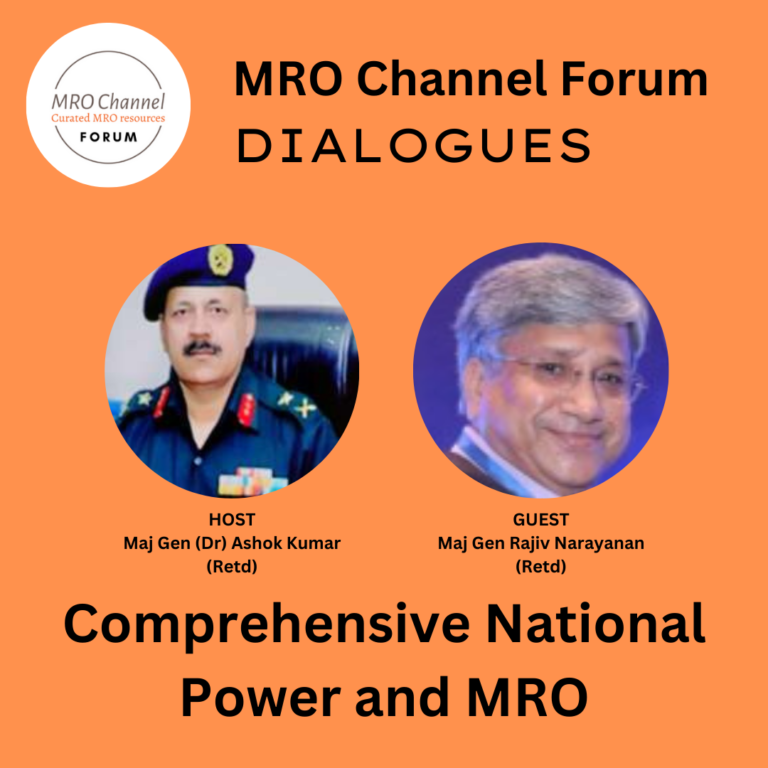
Comprehensive National Power and MRO. Interview of Maj Gen Rajiv Narayanan by Maj Gen (Dr) Ashok Kumar

In a recent dialogue, Maj Gen (Dr) Ashok Kumar and Maj Gen Rajiv Narayanan discussed MRO's role in boosting India's comprehensive National Power. Maj Gen Narayanan highlighted the importance of a robust MRO ecosystem, the strategic opportunity for maintaining Soviet-era equipment for other countries, and the role of skilled human resources. He stressed the need for stable infrastructure, balanced labor laws, and effective education. He recommended phased goals: succeeding in MRO, attracting R&D, bringing in OEMs, and establishing India as a major manufacturing hub. Maj Gen Kumar emphasized increasing awareness and strategic decision-making to position India as a reliable MRO hub globally.

The Symbiotic Relationship between Indigenization and Maintenance, Repair, and Overhaul (MRO) in Advancing Nations

In today's global competition, having cutting-edge machinery is crucial. This requires both indigenization, producing advanced machinery domestically, and effective Maintenance, Repair, and Overhaul (MRO) practices. Indigenization relies on investing in research and development to foster innovation, while MRO ensures machinery's continuous efficiency and absorbs technology from imports. Strategically locating MRO facilities is vital, especially in remote areas. Decision-makers must balance crisis responsiveness and shareholder interests. Ultimately, investing in both indigenization and MRO is essential for a nation's resilience and prosperity, emphasizing the importance of technological self-reliance in an ever-evolving world.

Enhancing Comprehensive National Power through MRO

The dialogue with General Matharu explores the potential of Maintenance, Repair, and Operations (MRO) in India. General Matharu discusses the opportunities and challenges of MRO, the link between MRO and Comprehensive National Power (CNP), and the role of veterans in equipment maintenance. He emphasizes the need to create MRO hubs in India and set a goal to become a global MRO leader. The MRO Digest Forum, which he established, serves as a platform for MRO professionals to contribute to this goal. Overall, the dialogue encourages MRO experts to share their knowledge and expertise.

How is battery technology powering the future?

In this interview, Brig YVR Vijay (Retd) discusses the challenges faced by lithium-ion battery technology, including issues with performance degradation, safety concerns, and environmental impact. He then outlines key trends in battery technology for the next two decades, focusing on improving energy density, reducing costs, and enhancing environmental friendliness. Vijay also highlights the top alternatives to lithium-ion batteries, including lithium-ion phosphate batteries, solid-state batteries, sodium-ion batteries, zinc-air batteries, and more, each catering to specific applications and requirements. The interview emphasizes ongoing research and development efforts to create more efficient, cost-effective, and environmentally friendly battery technologies for electric vehicles and renewable energy.

A Talk on Electric Armoured Fighting Vehicles

The discussion explores the potential, challenges, and advantages of Electric Armoured Fighting Vehicles (E-AFVs) in different roles and environments.
The discussion highlights the electrical component challenges of E-AFVs, especially for tanks, which require large, high-energy-density batteries for silent operation and electric motors for high torque and agility.
The discussion suggests replacing lead acid batteries with lithium-ion ones or using hybrid systems to balance internal combustion and electric power for E-AFVs.
The discussion also emphasizes the benefits of E-AFVs in terms of maintenance, fire hazards, amphibious capabilities, and tactical flexibility.

A talk on main battle tank design

The main battle tank is a complex vehicle designed with various components and systems, with careful consideration of balance between firepower, mobility, and protection. Starting from the ground up, it consists of running gear (tracks and bogie wheels) for mobility, supported by a suspension system to absorb shocks. The tank is divided into three compartments: driver's, fighting, and engine. The turret in the fighting compartment houses the main gun, with systems for gun control and fire control. Protection is achieved through armor, with a focus on the frontal arc. The tank's design requires trade-offs between size, firepower, and protection, and various armies have developed different tanks based on their unique requirements. Despite advancements in other weapons, the main battle tank remains a lethal force on the battlefield.